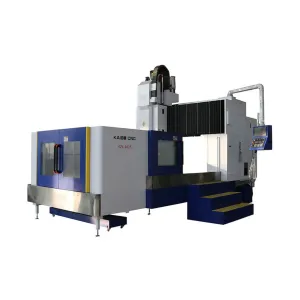
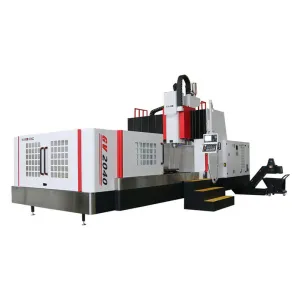
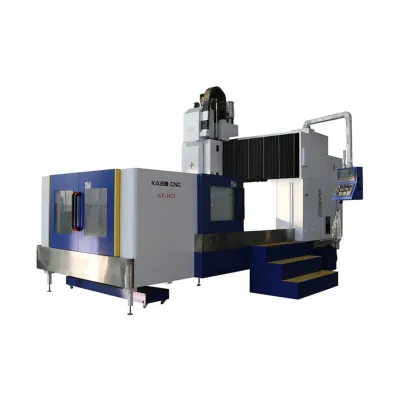
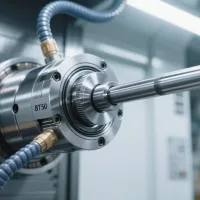
Manufacturing large composite layup molds presents inherent challenges: insufficient machining precision, extended production cycles, and unstable cutting processes can severely limit throughput and quality. The GV1625 double-column CNC milling machine, engineered with a rigid steel frame, addresses these core pain points by providing a stable and highly precise milling platform tailored for composite structural parts. This article examines how the GV1625 breaks through traditional bottlenecks to elevate finishing quality and operational efficiency in demanding composite mold fabrication scenarios.
Central to the GV1625’s performance is its robust rigid steel framework, designed to minimize vibrations and thermal deformation during heavy-duty milling. The machine’s dual-column gantry setup ensures machining forces are evenly distributed, preserving positional accuracy across large travel distances (X=1600mm, Y=2500mm, Z=850mm). Its optimized mechanical stiffness achieves less than 0.01mm positional deviation—a critical factor for composite molds where tolerances often demand sub-50 micron precision.
Enhanced dynamic stability also means operators experience consistent surface finishes, reducing the need for costly post-processing. In practical terms, the GV1625’s design improves directional rigidity by 25%, resulting in a 30% decrease in surface roughness (Ra reduced from 1.6μm to 1.1μm in typical composite layup molds). This directly elevates mold quality, ensuring better layup conformity and, ultimately, part performance.
The GV1625 shines in versatility across different composite components: from aircraft fuselage frame molds and wind turbine blade cores to automotive battery trays. Its machining envelope accommodates oversized tools and multi-axis operations necessary for contoured molds. The machine’s compatibility with advanced CAD/CAM workflows accelerates programming for multi-surface machining, vital for molds incorporating complex curvature and embedded cavities.
Additionally, the GV1625 supports a variety of tooling systems calibrated for carbon fiber reinforced plastics (CFRP) and other advanced composites, reducing delamination risk and tool wear. Such integration streamlines production pipelines, enabling manufacturers to maintain consistent output quality irrespective of composite complexity.
The GV1625’s integrated control algorithms proactively compensate thermal expansion and track tool wear trends, ensuring that every machining step meets tight specifications. With a thermal drift control within 0.005mm/hour, the stability of mold dimensions is vastly improved during extended runs. Its adaptive feedrate optimization reduces excessive tool engagement on complex contours, balancing machining speed and part surface integrity.
Operators benefit from an intuitive HMI combined with real-time diagnostics, which minimize unplanned downtime and facilitate rapid adjustment to varying composite layup designs. This holistic approach directly addresses manufacturers’ most pressing requests: "solutions that solve your core machining pain points and make each process step precisely dependable."
 277
|
277
|
 FANUC GV2030
heavy-duty machining center
smart factory transformation
CNC machining efficiency
industrial automation
FANUC GV2030
heavy-duty machining center
smart factory transformation
CNC machining efficiency
industrial automation
 315
|
high speed cnc milling machine
gv6050 precision machining
dual column vertical machining center
heavy cutting cnc machine
precision milling solutions
315
|
high speed cnc milling machine
gv6050 precision machining
dual column vertical machining center
heavy cutting cnc machine
precision milling solutions
 241
|
DC2025 Gantry CNC Milling Machine
Large Mold Machining
Machine Rigidity Advantages
Improving Processing Efficiency
CNC Milling Applications
340
|
GV6050 CNC milling center
high-speed heavy cutting
efficient milling
milling time reduction
hard material machining
241
|
DC2025 Gantry CNC Milling Machine
Large Mold Machining
Machine Rigidity Advantages
Improving Processing Efficiency
CNC Milling Applications
340
|
GV6050 CNC milling center
high-speed heavy cutting
efficient milling
milling time reduction
hard material machining
 60
|
DC1417 CNC milling machine
large gantry CNC mill
medium to large mold machining
high-speed heavy-duty machining
cnc milling machine for molds
60
|
DC1417 CNC milling machine
large gantry CNC mill
medium to large mold machining
high-speed heavy-duty machining
cnc milling machine for molds