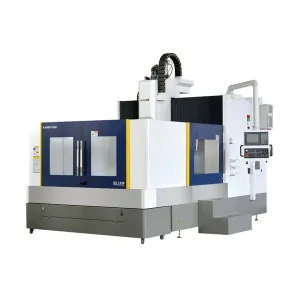
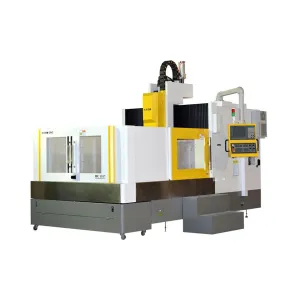
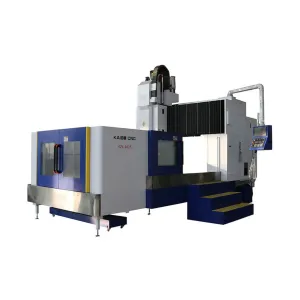
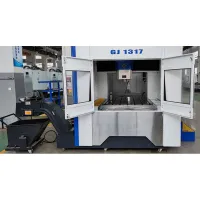
Large-scale mold manufacturing often faces critical challenges: inconsistent product quality and bottlenecks in processing efficiency. These issues translate directly into increased defect rates and ballooning operational costs, hindering competitive edge and profitability. The DC1520 high-precision CNC milling machine emerges as a specialized solution engineered to conquer these challenges with its exceptional size capacity and advanced structural design.
Mold makers handling parts with dimensions extending beyond a meter frequently battle with precision loss caused by machine vibration, thermal deformation, and unstable tool paths. These factors contribute to quality fluctuations and unplanned rework, causing defect rates that often exceed 8-12% in traditional setups. Additionally, insufficient rigidity in milling centers limits spindle speeds and feed rates, capping throughput despite rising demand.
The DC1520 presents a structurally robust design with three-axis travel dimensions of 1500×2000×720 mm, ideally suited for large molds requiring expansive machining envelopes. Its superior rigidity — achieved through a monolithic cast iron frame and reinforced bridge structure — minimizes vibration and thermal distortion during heavy cuts.
At the heart of the DC1520 is an ultra-high precision ball screw and advanced linear guideway system, jointly delivering positioning accuracy within ±0.005 mm. This precision directly translates into cutting process predictability, drastically reducing dimensional deviations and subsequent defects.
Maintaining dimensional accuracy during large mold milling is paramount. The DC1520’s integrated thermal compensation system continuously monitors and adjusts for machine expansion, keeping precision error below ±0.007 mm even during prolonged operations at elevated spindle speeds.
This precision minimizes the need for manual finishing and part rework, leading to a significant 30% reduction in defect rates compared with standard CNC machines in similar applications. By firmly controlling machining tolerances, businesses can confidently scale production without proportional waste increment.
The DC1520’s high-rigidity framework enables faster cutting speeds without chatter or surface finish compromise. Enterprises report throughput increases of up to 40% post-implementation, enabled by stable high-feed milling combined with consistent tool life preservation.
Faster cycle times mean more molds delivered per shift while labor and energy consumption remain steady or even decrease, creating a direct cost-saving effect that scales with production volume.
Customer: Precision Moldworks Ltd.
Before DC1520 installation, defect rates averaged 11%, and batch throughput hovered at 75 molds/week.
After integrating DC1520 machines:
- Defect rate dropped to below 8%, a 27% reduction.
- Weekly output rose to 105 molds, a 40% uplift.
- Material waste decreased by 15%, lowering raw material costs substantially.
Outcome: Improved product reliability allowed Precision Moldworks to secure larger contracts, reinforcing market position.
Every defect avoided in mold manufacturing eliminates costly rework, scrap material, and production delays. By ensuring tight tolerances and stable machining conditions, the DC1520 not only preserves raw materials but also optimizes labor utilization—operators can focus on proactive quality assurance rather than corrective actions.
Simply put, reducing defect rates = direct cost savings. Your mold shop stops wasting time and resources on reprocessing and retooling. This efficiency gains translate into competitive pricing, higher margins, and greater customer satisfaction.
Let the DC1520 help you reclaim productivity and slash defect rates — making your mold shop a benchmark of precision and profitability.

 342
|
342
|
 DC1417 CNC milling machine
Medium and large-scale mold machining
Automotive parts machining
High-speed heavy-duty machining
Gantry CNC milling machine
DC1417 CNC milling machine
Medium and large-scale mold machining
Automotive parts machining
High-speed heavy-duty machining
Gantry CNC milling machine
 42
|
DC1417 CNC milling machine for automotive parts
medium to large mold processing
cost reduction and efficiency improvement
42
|
DC1417 CNC milling machine for automotive parts
medium to large mold processing
cost reduction and efficiency improvement
 100
|
Plastic Mold Making CNC Milling Machine DC1317
Big Type CNC Milling Machine for Mold Production
High Precision Plastic Mold CNC Milling DC1317
Heavy Duty CNC Milling Machine DC1317
Large CNC Milling Center DC1317 for Molds
Efficient CNC Milling for Plastic Molds DC1317
Robust CNC Milling Solutions DC1317
DC1317 CNC Milling Machine for Auto Parts
Advanced Plastic Mold CNC Machining DC1317
Precision CNC Milling Machine for Heavy Molds DC1317
100
|
Plastic Mold Making CNC Milling Machine DC1317
Big Type CNC Milling Machine for Mold Production
High Precision Plastic Mold CNC Milling DC1317
Heavy Duty CNC Milling Machine DC1317
Large CNC Milling Center DC1317 for Molds
Efficient CNC Milling for Plastic Molds DC1317
Robust CNC Milling Solutions DC1317
DC1317 CNC Milling Machine for Auto Parts
Advanced Plastic Mold CNC Machining DC1317
Precision CNC Milling Machine for Heavy Molds DC1317
 324
|
CNC milling machine for automotive parts
DC1417 heavy-duty machining solutions
high-speed precision CNC milling
324
|
CNC milling machine for automotive parts
DC1417 heavy-duty machining solutions
high-speed precision CNC milling
 346
|
DC1317 CNC milling machine
heavy-duty large mould machining
transmission stability
machining precision improvement
extended stroke milling machine
346
|
DC1317 CNC milling machine
heavy-duty large mould machining
transmission stability
machining precision improvement
extended stroke milling machine